Supporting mental health is about more than managing difficulties. It is also about helping people find purpose, build confidence, connect with others and discover what makes them feel good. At West Kent Mind, our Creative Health programmes use creativity, nature and shared experience to help people take positive steps towards better wellbeing.
Why Creative Health matters
Creative Health offers a different way into support. Someone who finds it hard to join a formal support group may feel comfortable coming along to paint, write, garden or play a game. The activity gives people a shared focus, so relationships develop naturally. Research shows that when we are busy with our hands, we are more likely to talk and open up, and this is especially true for men.
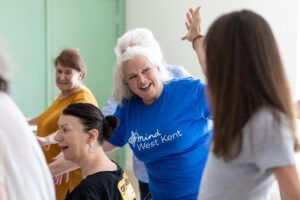
The wider evidence is strong too. Taking part in creative activity lowers stress hormones such as cortisol and reduces blood pressure and inflammation. It also helps reduce the risk of depression and loneliness. Studies suggest a return of more than £6 for every £1 invested in creative health programmes.
For us, the benefits fall into three areas:
- Connection and belonging: building friendships, reducing isolation and feeling part of a community.
- Confidence and purpose: learning new skills, trying something different and rediscovering interests.
- Improved wellbeing: having supportive spaces to express emotions, focus on the present and celebrate achievement.
Working to quality principles
Our work follows the Creative Health Quality Framework, funded by Arts Council England. Its eight principles are person-centred, equitable, safe, creative, collaborative, realistic, reflective and sustainable. They help us standardise our delivery and support artists who are new to working in mental health.
A diverse range of programmes
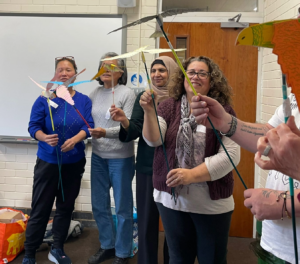
Creative Minds is our flagship six-month programme, now in its fourth year with funding from the National Lottery Community Fund. Participants work with professional artists and arts organisations. They have access to a diverse range of creative practice including creative writing, dance and movement, watercolour, photography, music, cooking, silk painting, printmaking, drama and local history. Over the last year we delivered:
- eight six-month programmes, made up of 192 creative workshops
- support for 94 participants, 71% of whom reported improved mental wellbeing
- training for 24 Creative Agents
- 20 creative sharing events, with 200 audience members
One participant told us:
It gave me back a purpose in my world… It’s given me my confidence back and also, friendship.
Until 2029, 30% of our Creative Minds delivery will focus on supporting refugee and migrant communities, neurodiverse adults, and LGBTQ+ people and their allies. Our research identified these groups as the most marginalised in terms of health inequalities across West Kent.
Arts & Minds is a more accessible starting point. These 12-week groups are funded by Shaw Trust and run by our Wellbeing Worker team, offered in-person across West Kent and online. Each week mixes art forms in a relaxed, supportive space. Participants make friends, and many keep meeting after the course ends. Some go on to Creative Minds, volunteering or peer mentoring.
Mindful Gardening shows that Creative Health doesn’t always mean making art in a traditional sense. This volunteer-led group meets weekly at our Sevenoaks wellbeing centre to look after a wildlife garden through the seasons. Members spend time outdoors, do gentle physical activity and share conversation and peer support.
Dungeons & Dragons is our online programme. It helps people connect through storytelling, teamwork, problem-solving and exploring identity. It gives them a sense of belonging without the pressure of conventional social interaction. We have worked with the Amelia Scott and Plymouth University to research the links between playing D&D, mental health and creativity. Participants say:
The community feeling when you play D&D is amazing.
Balance and Connect is our new perimenopause support offer, funded by Shaw Trust. It combines creative activity, nature-based experiences and peer support. Face-to-face sessions run in partnership with Kent Wildlife Trust and Kent High Weald Partnership, and online programmes gives people another way to take part. It shows how Creative Health can evolve to meet the needs of particular communities.
Empowering people with lived experience
We want people with lived experience of mental health to become advocates and facilitators within Creative Health. We do this by training and mentoring Creative Agents and developing Peer Mentors. We also offer them paid opportunities within our programmes, which helps build the professional arts and creative workforce. Some of our clients have gone on to become Creative Agents and Peer Mentors. One now runs her own weekly Artist Table and Maker’s Table crafting groups.
A new role: mapping Creative Health across Mind
Our commitment now reaches beyond West Kent. With support from the Baring Foundation, West Kent Mind is taking on a new role: mapping Creative Health activity across the national Mind federation. Local Minds are already doing creative work, from arts groups to nature-based projects and peer-led activities. Bringing it together will show how much is happening, where the strengths are and where there are gaps. It will also help local Minds share learning and good practice with each other.
We are proud to be trusted with this work. It builds on what we have learned from our own programmes: there is no single creative approach that works for everyone, so people need a range of ways to take part.
Get in touch
Want to know more about our Creative Health work, or interested in working with us? Contact Julie.neville@westkentmind.org.uk.
West Kent Mind’s Wilder Wellbeing programme featured in our report, Creatively Minded and Green.
