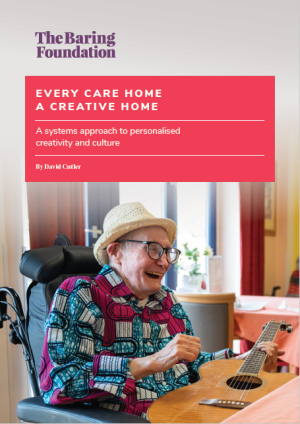
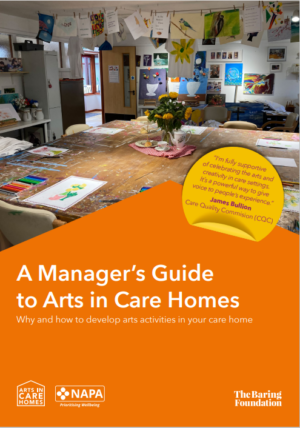
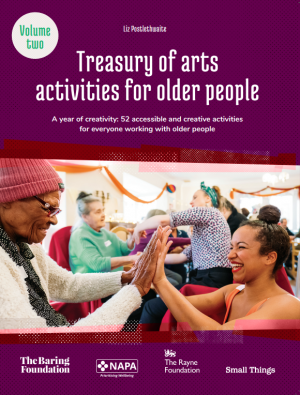
Recently I went to see Care by Alexander Zeldin at the Young Vic in London. As I joined the standing ovation at the end, I thought it was the best representation I had seen of care home staff, residents and their families. A lot of reviews have rightly commended the performance of Linda Bassett as a grandmother whose dementia and frailty increases while she is living in a home. Her family, especially her daughter, feel guilty about what support they can offer. But for me the best performances were by Aoife Gaston and Llewella Gideon as two of the care staff, especially in the amazing silent, almost religious, bed bath scene.
For a long time while the I led the Baring Foundation’s programme Arts and Older People, I was surprised how little art was made about people who lived and worked in care homes. Admittedly, most older people will not live in a care home but at over 400,000 people in the UK and staff of around 750,000, that still produces a population the size of our second city, Birmingham.
What work was made seemed to be a genre of film that was not to my taste and more about giving older actors opportunities. I cite The Best Exotic Marigold Hotel. It is hard to think of anything further removed from Zeldin’s Care. Perhaps very slightly closer is the care home for musicians in Quartet, a 2012 film based on a play by Ronald Harwood, but still a fantasy.
I know it has its fans but I put the Richard Osman series of detective stories in a similar category. This impression was aided by the Netflix adaptation of The Thursday Murder Club, which I watched thinking, who are these people, clearly a lot fitter than me, who seem to be living in apartments in a palace somewhere that is sort of both the UK and USA? Anyway, Osman is on to title five so a lot of people obviously disagree. And don’t get me on to Allelujah. The 2022 film in my view is slightly better than Bennett’s play at the National Theatre 2018. In the film it is clearer that it is an elderly care hospital while the play seemed confused about if it was a care home, a nursing home or a hospital.
There hasn’t been much attention to care homes in the visual arts either. However, some of the great paintings of the Dutch Golden Age are about the equivalent of care homes, alms houses, still very visible for instance in Haarlem. Some of the most famous are by Frans Hals, but we see the Governors showing their status as philanthropists. In the more recent past, the Royal Photographic Society ran a marvellous recent project during the Covid epidemic called Portraits of Care, working with artists and residents in care homes in Bristol to produce portraits for an exhibition.
Overall, there still isn’t much drama or arts representing life in care homes. And it is a hugely important part of our national story.
Meanwhile the Baring Foundation remains concerned to see more high-quality arts participation in care homes for residents and staff. To that end we have recently made a grant to Equal Arts to lead a partnership to advocate for this, as well as funding the National Activity Providers’ Association (NAPA) to create a resource about engaging men in care homes in creativity.