A resourceful field
The field of arts and mental health has always been resourceful, which is one reason there are so many organisations working creatively at different scales in communities across the UK. Many were founded with no funding but much commitment from people sharing a strong creative practice and a desire to serve particular communities. Over time, they have developed mixed models of earned and contributed income. Today, maximising the use of resources is even more vital, given the operating environment of squeezed funding, intense competition and rising costs.
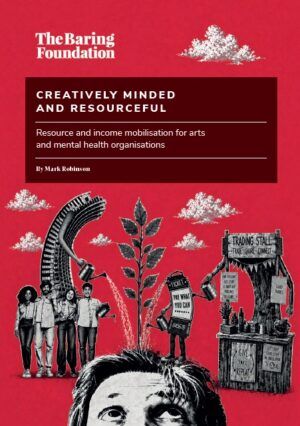
I hope Creatively Minded and Resourceful will be a practical resource in itself for those serving people with mental health problems via creativity. Being resourceful in the arts and mental health field is demanding work undertaken in precarious conditions. The aim of this publication is not to add pressure but to recognise the capabilities organisations already possess, and to increase awareness of potential strategies. There are no silver bullets here. But there are possibilities.
There are no silver bullets here. But there are possibilities.
Resourcefulness as I frame it here is not aimed at “doing more with less” or “becoming less grant-dependent”. (It became clear in our research that the most resourceful and inventive organisations actually tend to use grant funding as part of their financial mix, rather than simply replacing or avoiding it.) It is about doing what matters most to you, using everything you have, keeping a firm hold of your why, and building on the quality of your work and the demand for it.
Four types of resource
We focus on four typical types of resources that serve purpose and delivery:
- people and their skills: creatives, volunteers, peers, staff and governance;
- relationships, networks and partners;
- physical resources;
- income: revenue streams.
These are illustrated through 14 Case Studies. They cover a range of sizes, artforms, creative practices and situations, and very different efforts to improve sustainability.
In relation to people Belfast Exposed and darts in Doncaster show how investing in staff capability builds long-term resilience by supporting trading, training offers or partnership work. Arts 4 Wellbeing demonstrate how peer support shapes community-led models, while ARC Stockport and others use volunteers as a key part of delivery models.
Partnerships serve different functions. Some, such as Space2, use consortium working to access larger scale funds, with other including Blind Tiger and Mental Fight Club work with larger organisations to share ‘back office’ service, equipment or spaces. Company Chameleon have expanded their offer through partnerships rooted in artistic production.
Physical resources are used very differently. For some like Chilli Studios long-term homes enable membership/subscription income and community involvement. Others such as Compass Community Arts use partners’ spaces to deliver mutual benefit and lower costs. Skippko have an ‘empty buildings into creative spaces’ offer to landlords which generates unrestricted income through rents and donations.
Resources often generate income but opportunities and challenges around diversifying of income streams are important to consider. Hospital Rooms show the layering and leverage of arts and health match funding and trading income, while Choirs for Good use grant funding to test models and build evidence data. Soundcastle show the importance of managing fluctuations in income while still developing new offers and caring for staff.
Start with who you are and what you have
The report includes a ‘Resourcefulness Canvas’ which can be used to describe or design a business model centred on use of these resources in pursuit of a mission. This is one of a suite of appendices – availably individual online – that offers practical frameworks to help with typical choices such as when to take on new projects, how to leverage partnerships or make the most of physical assets, or how to avoid mission drift.
I suggest ten potential starting points for anyone are thinking about how best to use or generate resources. Like all the lists in the report it is illustrative rather than comprehensive, and definitely not prescriptive: every organisation needs to develop resources and ways to use them that suit their identity purpose and values, and their situation.
Instead of highlighting a bright idea – there are (at least) 24 of those in the report that might spark thoughts for you – I will close with two starting points I think are vital.
Start by thinking of what you already have or can access, and how you might use it more, especially if you are able to use proven demand to create new partnerships or income streams.
And then, however you use resources or generate income, hold on tight to your own particular “why” – your creative model, skills and values, and most crucially the people with mental health problems you serve. That may be the most important resource of all.
Mark Robinson is the author of Creatively Minded and Resourceful. He founded his consultancy Thinking Practice in 2010 and writes, facilitates, coaches and advises across the cultural sector.