Too often, artists disappear from view as they grow older, despite having decades of experience to share.
For more than thirty years, Balbir Singh Dance Company has explored how classical Indian dance can speak to contemporary Britain. Our performances draw on the traditions of Kathak while embracing collaboration across cultures, generations and artistic disciplines. Alongside our touring work, we have spent decades working with older people, carers, people living with dementia and Parkinson’s, refugee communities and those experiencing isolation or chronic pain.
Although every project is different, they all begin with the same question: how can creativity become part of everyday life?
Creative ageing is often measured by participation. We count workshops, audiences and projects delivered. These figures matter, but over the years we’ve found ourselves asking a different question. What happens when people leave?
Do they continue to notice beauty in the world around them? Do they discover new ways of expressing themselves? Do they feel more confident to connect with others? Do they begin to see themselves as creative, not just during an activity, but in the ordinary moments that make up everyday life?
For us, that is where creative ageing truly begins.
One of the most important lessons we’ve learnt is that creativity rarely starts with dance. It starts with trust.
Many people arrive believing they are “not creative”. Others are uncertain about joining a dance session or anxious about stepping into an unfamiliar environment. Rather than asking people to move straight away, we create gentle opportunities to connect.
Sometimes that means shaping clay to give form to pain that words cannot describe. Sometimes it means exploring colour in a museum, photographing nature on a woodland walk or simply noticing how light falls through the trees. These are not distractions from artistic practice. They are artistic practice. They encourage people to observe, imagine and express themselves without the pressure of getting something right.
This philosophy has led us to work in museums, botanical gardens, marketplaces, community centres and healthcare settings, often in partnership with universities, researchers and cultural organisations. Every setting offers a different way into creativity, but the purpose remains the same: helping people find a creative vocabulary that belongs to them.
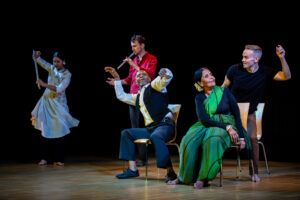
Our recent production, The Wise Ones, brings together an intergenerational cast that includes performers in their eighties alongside younger artists. The work isn’t about celebrating age as an abstract idea. It asks what becomes possible when experience, memory and youthful energy occupy the same creative space.
In many cultures, older people are viewed as the keepers of knowledge, yet our stages rarely reflect that understanding. Too often, artists disappear from view as they grow older, despite having decades of experience to share.
At Balbir Singh Dance Company, we believe that older artists remain central to the creative life of our communities. They are mentors, collaborators and storytellers whose lived experience enriches the work for everyone around them. Intergenerational practice is not simply about representation; it creates better art.
This belief has shaped my own journey as an artist.
My guru, the late Guru Pratap Pawar, gave his final public performance at the age of eighty-three. In the guru-disciple tradition, learning extends far beyond movement. It is about values, generosity, curiosity and the responsibility to pass knowledge from one generation to the next. Watching Guruji continue to perform with such depth and humanity reinforced something I have carried throughout my career: creativity is not something we grow out of. It is something we continue to deepen.
Perhaps that is the conversation we need to have more often.
Creative ageing is not simply about providing opportunities for older people to take part in the arts. It is about creating the conditions in which creativity becomes part of everyday life. The workshop, performance or exhibition is only the beginning. What matters is what people carry with them afterwards.
The workshop, performance or exhibition is only the beginning. What matters is what people carry with them afterwards.
If someone leaves one of our projects noticing the changing seasons, picking up a camera again, finding the confidence to express themselves or beginning a conversation they never thought they could have, then creativity has already travelled far beyond the studio.
As artists, that is what continues to inspire us. We don’t simply want to create memorable performances. We want to create moments that stay with people long after the curtain falls, nurturing curiosity, confidence and connection throughout life. In a society where we are living longer than ever before, perhaps creativity is one of the most valuable companions we can grow old with.