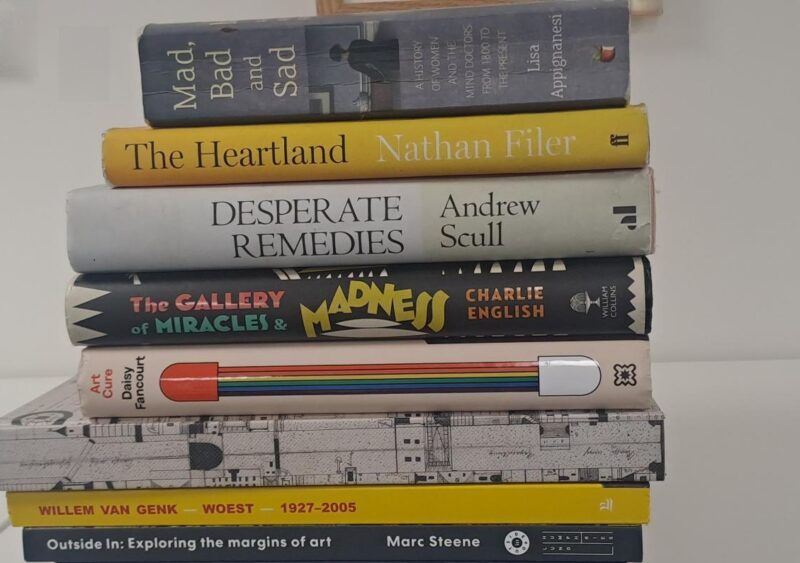
I have resisted the temptation to post a beaming mugshot of myself next to a fresh copy of The Art Cure by Daisy Fancourt which seems to be a popular social media pastime. I thought I would be radical and read it instead. It’s great. But I am baffled by the ‘ground breaking’ reviews because it is what Daisy has been saying for almost a decade, along with a number of others. That is, simply, that we now have substantial scientific evidence of the many health benefits of participation in the arts. Also that, while these vary between art forms and health conditions, there are also more generalisable population level benefits. Professor Fancourt is a brilliant communicator. She leavens the science (of which there is plenty) with individual case studies and her personal experience. I found the most moving part of the book at the end, when arts can no longer offer health improvement or remission. In palliative care, in someone’s last days, the arts can give meaning, pleasure and joy.
The Baring Foundation funds creative activity for people with mental health problems. So, although we accept the significance of health gains, we are also interested in the value of artistic expression for its own sake. That means both the quality of that art and of participatory facilitation. Creativity for and by people with severe and enduring mental health problems is for good reason a fraction of The Art Cure. So I wanted to mention a selection of other books which I have found good reads along the way of our funding over the last six years.
We now have substantial scientific evidence of the many health benefits of participation in the arts
Books about mental health alone could, of course, occupy many libraries. The first thing to note is that psychiatry has both helped many people and also been a curse for many others, especially in the past. The best account of this dark and discriminatory history is Desperate Remedies by Andrew Scull (who has many other histories of mental health to his name). Psychiatry: A Very Short Introduction by Tom Burns for a lay person like me is an ideal general starting place. A superb account of the gendered nature of psychiatry is Mad, Bad and Sad by Lisa Appignanesi. There are very good accounts of particular conditions such as Heartland by Nathan Flier on ‘schizophrenia’ and Noonday Demon by Andrew Solomon on depression. And I can’t conclude this section without mentioning the superb catalogue of the 2016 Wellcome exhibition written by Mike Jay and called This Way Madness Lies. It is wonderfully illustrated and packed with examples of the arts in psychiatry.
There are many semi-fictionalised accounts of living with mental health problems by great writers such as The Bell Jar by Sylvia Plath and I Never Promised You A Rose Garden by Joanne Greenberg. In terms of playscripts, particular favourites of mine are Blue Orange by Joe Penhall and People, Places, Things (about addiction) by Duncan Miller.
I am especially interested in visual arts and there is a wealth of books available here. Whether it is the biography of Munch by Sue Prideau or of Van Gogh while he was producing a masterpiece on an almost daily basis in Arles in Starry Night by Martin Bailey. There are many books on so called Outsider Art, including by Marc Steene the founder of the eponymous Outside In. I particularly like The Gallery of Miracles and Madness (terrible title – blame the publishers?) by Charlie English which largely explores the extraordinary history of the Prinzhorn Collection of art by psychiatric patients.
Turning to music, in some ways a companion piece to The Art Cure, and just as well written, is Music as Medicine by Daniel Levitin, who is a neurologist as well as a musician. (I note that Daisy is a musician too – clever lot). Many composers have lived with mental health problems too, most famously Robert Schumann as explored in Schumann: The Faces and the Masks by Judith Chernaik.
I want to end on the shortest book and the most creative. Lorina Bulwer is a biographical pamphlet written by Dolly Sen, an artist with lived experience of mental health problems who has been kind enough to write for the Baring Foundation. This is vintage Dolly. It is the powerful (and funny) story of a 19th-century needlewoman, living in an asylum and using her embroidery for protest.
The relationship between creativity and mental health is endless – we will need a very long bookshelf.