Yoko is the founder of Arts Alive in Tokyo.
The roots: conviction through diversity
My journey into creative aging began 25 years ago, inspired by an international symposium hosted by Arts for Health in the UK. In the early days of Arts Alive in Tokyo, we provided artist-led workshops not only for seniors but for a wide range of people, including mother-and-child support facilities, centers for multiple disabilities, and children’s hospitals. Witnessing the transformative power of art across such diverse circumstances gave me a firm conviction: art is a vital tool for human dignity and resilience.
Innovation: ARTRIP and the new generation of ageing
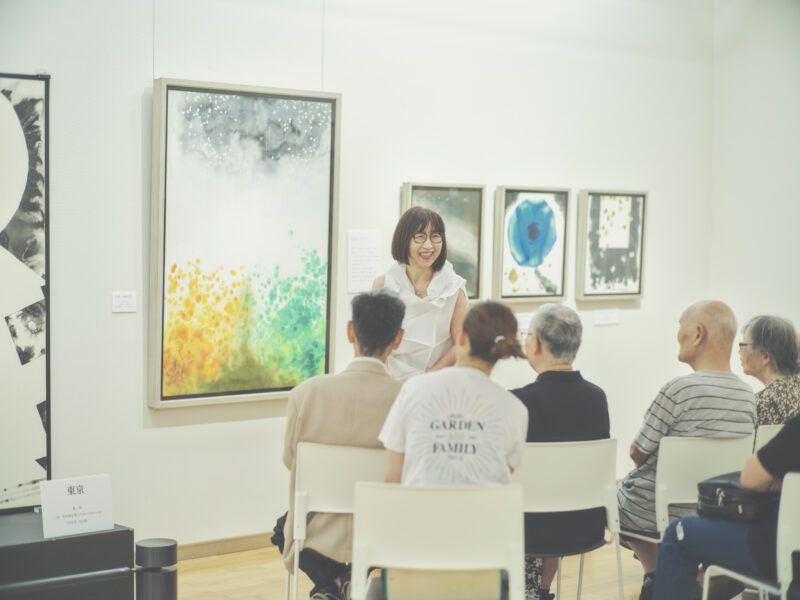
In 2009, I formalised our mission as Arts Alive. Following my research as an Abe Fellow in the US, I developed “ARTRIP” – a dialogue-based art appreciation programme. We focus on “psychological safety”, creating a space where everyone is accepted exactly as they are. This approach has allowed us to extend our reach to individuals facing social withdrawal (hikikomori) and mental health challenges.
As the highly educated post-war generation enters seniority in Japan, we see a surging demand for intellectually stimulating programmes. ARTRIP meets this need by moving beyond traditional “care” toward a sophisticated cultural experience. To date, we have trained 400 Art Conductors, and ARTRIP is increasingly recognised as a key element of social inclusion.
Overcoming barriers: scientific evidence and social prescription
Initially, Japanese care providers feared that art might “overstimulate” those with dementia. To bridge this gap, we prioritised scientific validation. In addition to our clinical trials with the National Center for Geriatrics and Gerontology, we participated in “A-Health”, an international clinical trial led by McGill University in Canada. Our activities are also formally recognized as “Delight-Based Emotional Therapy”, a method advocated by leading Japanese physicians. These studies proved that art dialogue significantly reduces depression and improves verbal recall.
A significant breakthrough occurred after our 2018 international symposium. A participating physician was so moved by the programme that he began attending ARTRIP sessions himself. He later invited me to lecture at a seminar for dementia specialists and now actively recommends ARTRIP to his patients. This demonstrates how “social prescribing” is taking root in Japan, moving from clinical validation to heartfelt medical endorsement.
Returning to the UK: The magic of Barrow-in-Furness
This October, the journey came full circle. Recommended by the Baring Foundation, I was invited to the “Creative Aging: What’s Next?” festival in Barrow-in-Furness. At a care home in Westmorland and during the festival, I introduced participants to Sumi-e (ink wash painting) using Japanese brushes and Washi paper, exploring the concept of “Ma” (the beauty of empty space).
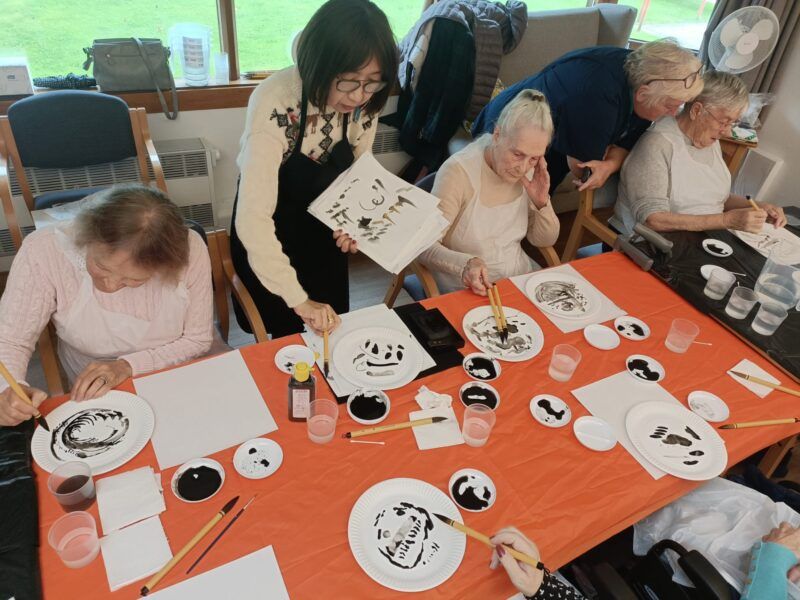
One remarkable highlight was a local gentleman who attended every single one of my four workshops. Each time, he brought a different loved one—first his friend, then his daughter, and finally his wife. Furthermore, at every care facility, the staff were astonished. They told me, “It is truly rare to see every single resident, regardless of their condition, successfully complete a piece of work”. Seeing the pride on their faces reaffirmed that art can unlock the potential in everyone.
A vision for the future: Bringing the festival home
Visiting the Dementia Arts Festival in Scotland and the vibrant events in Barrow was a revelation. Seeing seniors over 60 joyfully engaging in everything from Indian dance to Brazilian samba – accompanied by the quintessential British tea time – reminded me of the pure joy that arts bring to later life.
Inspired by this experience, I am now planning to launch a similar Creative Ageing Festival in Japan next year. I want to bring that same spirit of celebration and international exchange to our ageing society. My deepest thanks to the Baring Foundation for this invitation; it has provided the spark for the next chapter of Arts Alive.