Why the Germans do it better, the 2020 book by John Kampfner, definitely crossed my mind after I visited the SeelenArt day centre ‘Tagesstätte’ in the town of Haar outside Munich at the end of October.
Haar is a small place but famous for its mental health hospital, a version of which has been there since 1905. (Its history is recorded in a small museum, unfortunately shut when I went.) The hospital is still there for acute care, but as in the UK, the practice of psychiatry underwent a major philosophical shift in the late 1970s and 1980s, and the majority of mental health services are now delivered via outpatient services in the community.
Clinical outpatient services are supported by a not-for-profit agency (kbo-Sozialpsychiatriches Zentrum) which offers a range of support to people living with mental illness in the Upper Bavaria region. That includes help with accommodation, employment, leisure activities and art and culture. Much of the offer seems to be predicated on the principle that having social connections, interests and something to do are all important for recovery and staying well, and even if you’re not that well.
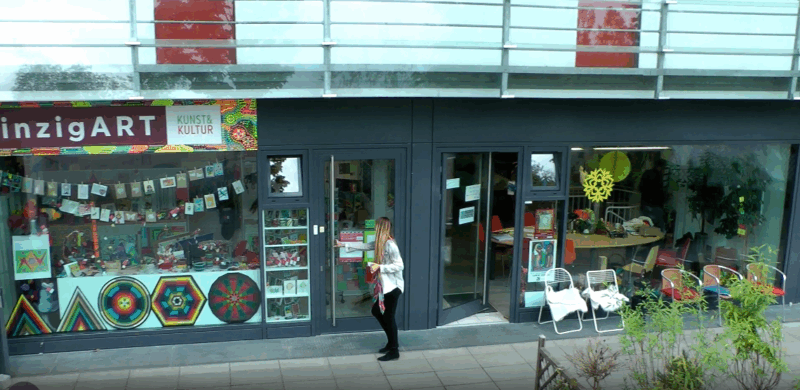
SeelenArt is one of the services offered and is a supported art studio and day centre. Their premises in Haar are warm and friendly, with two art rooms, a kitchen, small shop, office and a basement full of art. A little garden area outside provides somewhere to sit in good weather and one of the artists had created sculptures out of found materials for the space.
Led by an art therapist with support workers, the studio is open five days a week 10:30 to 4:30. About 60 people attend, but usually about 10 or so at any one time. People are free to drop in an out. Some come several times a week; some have been coming for years. It’s free. In the tradition of a supported studio, artists come and work on their own projects and follow their own artistic ambitions and interests. However, there is a busy timetable of other creative activities, including:
- a weekly music group
- cooking together
- a weekly drawing class
- daily demos of painting techniques on request
- a weekly dance workshop
- a weekly theatre group
- a monthly discussion group on film, book or work of art
- group visits to museums, galleries and the theatre
Days start with a group chat – with coffee and a roll.
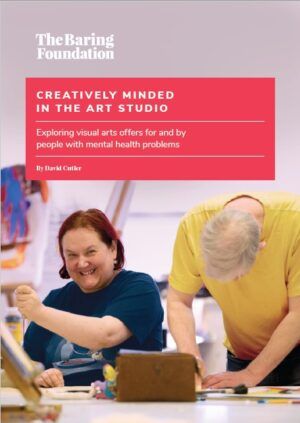
So far, not so different from a number of organisations in the UK. The Foundation has recently published a report – Creatively Minded in the Art Studio – which focuses particularly on visual arts opportunities for people living with mental health problems, including 16 case studies of UK arts organisations. Chilli Studios in Newcastle, Project Ability in Glasgow, and Studio Upstairs in London and Bristol are probably SeelenArt’s closest cousins.
However … the core work of SeelenArt – that is the supported studio/day centre – receives statutory funding, which possibly makes it a rich relative (or relatively so).
It probably doesn’t feel like that, however, and SeelenArt has a couple of other projects, which they do fundraise for. One is their gallery space in central Munich where their artists can exhibit work. The current exhibition is themed around climate change.
Another is their biennial art prize which is open to local artists who address the theme of mental health through art in their work, use creative expression to support their mental health, or who have experience of psychiatric services. In 2022, they received over 617 entries. Prize winners have the opportunity to have their work exhibited in an exhibition and featured in a nicely produced catalogue.
People I spoke to in Munich admired the UK’s vibrant participatory arts sector and the ambition and progress of our arts and health sector. However, Germany also has its gems and SeelenArt (and the wider European tradition of supported studios) is definitely one of them.
Whilst in Munich, I also visited the city’s third annual Mental Health Arts Festival, hosted by the Gasteig HP8 arts centre and funded by the Beisheim Foundation. The festival took place over a week in later October and included performances (including by the Manchester based dance organisation, Company Chameleon), workshops, exhibitions and open mics. A fourth year is currently uncertain – however, it joins a handful of arts festivals focused showcasing work by people living with mental health problems and talking about mental health. Others we know about include The Rendezvous with Madness festival by Workman Arts in Toronto (in its 32nd year!), First Fortnight in the Republic of Ireland, NIMHAF in Northern Ireland and perhaps the biggest, Scotland’s Mental Health and Arts Festival. If you know of others, we’d love to hear about them.