Last week, the Baring Foundation visited Finland to attend the Helsinki meeting of the International Creative Ageing Network (iCAN), which we set up in collaboration with Kaapeli (the Cable Factory in English), Finland’s largest arts centre.
Finland, and particularly the City of Helsinki, has taken a strategic approach to embedding the cultural rights of older people into the social fabric, with which there are few, if any, comparisons anywhere else in the world. So, although we have written extensively and admiringly about creative ageing in Finland before, including in our joint report with colleagues at Kaapeli in 2021 – Love in a Cold Climate, here are four principles and highlights of the Finnish creative ageing world.
1. Collaborate
Since the early 2010s, the municipal culture departments and health and welfare departments of several Finnish cities have funded and supported shared positions responsible for considering access to culture for older local residents. Jenni Räsänen (co-author of Love in a Cold Climate) has been doing this role for the City of Helsinki for a number of years.
Excitingly, there are now parallels with the UK, with the roll-out of Creative Health Leads in Integrated Care Systems in England and the Arts and Health Coordinator roles in health boards in Wales – both funded partly by arts and culture funding and partly from health. These UK roles are broader and cover large swathes of territory geographically, but they will encompass culture and social care, as well as health services.
2. Deliver
Service centres (the translation doesn’t do these justice) are all-singing all-dancing integrated care centres for older people with high-quality arts and culture offers. They are somewhat similar to the UK day centre (which have experienced huge cuts in the UK in recent years) – open access and drop-in, with 10% of Helsinki’s retired population using them.
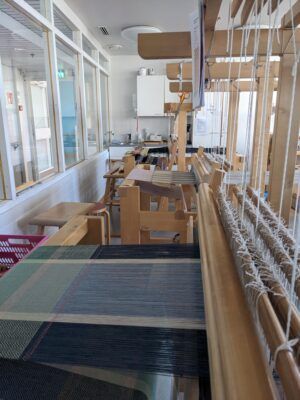 Service Centres have ‘cultural instructors’ – employees with an arts or producing background – who deliver the arts and cultural programmes. The Service Centre we visited has wonderful arts facilities, with studios for metal-working, ceramics, and even one for weaving, equipped with several looms (see left).
You can read more about both the shared employees, service centres and cultural instructors in Love in a Cold Climate.
3. Fund
In 2020, City of Helsinki decided to allocate funds it received through unclaimed inheritances to activities that promoted the wellbeing of its older residents. That budget in 2025 was 2 million euros, 1.3 million of which was for cultural activities. The Cultural Department is currently funding 32 projects taking place all over Helsinki.
Through this funding, music organisations have created neighbourhood bands and choirs; dance schools have piloted new teaching methods and movement practices for older people; circus organisations have held intergenerational workshops; and theatre groups have collected stories and memories to create performances.
The Arts Council Northern Ireland is the only UK public funder currently with a dedicated fund for arts and culture for older people.
You can read more about this Helsinki initiative in another of our recent publications, Creative Ageing and Men.
4. Make visible and celebrate
Our fantastic Finnish partners – Kaapeli – have run the Finnish creative ageing festival, Armas – for ten years. Armas was first inspired by Scotland’s creative ageing festival, now development agency, Luminate. In 2026, Armas ran across the last two weeks of March, with over 200+ events.
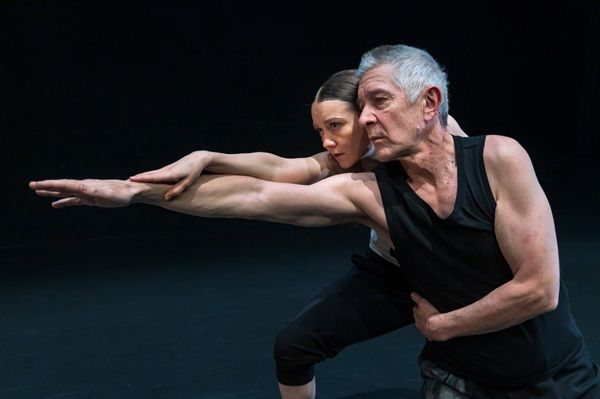
We went to see the fabulous Susanna Leinonen’s Dance Company at the National Theatre as part of the festival. The group is an intergenerational collaboration between professional dancers and older people and they are extremely good (see photo). Their performance was for me a reminder that loneliness can occur at any time of life and the importance of intergenerational shared spaces.
That point was also beautifully made by Elisa Tiilikainen, a Finnish academic who spoke about the nature of loneliness at the iCAN seminar, alongside presentations of national examples from the UK, Japan and Finland.
You can watch the full iCAN seminar here (available for 2 weeks from 7 April 2026).
If you’d like to sign up to the iCAN network and join the next meeting, you can do so here.
In the meantime, as ever, let’s all be more Finnish!
